Santa Claus
Despite the fact that he has many names, Holy person Nicholas, Holy person Scratch, Kris Kringle, Father Christmas, St Nick, Santy, and so on, Santa isn't one of them. That is a title held exclusively for the Christmas film. St Nick Claus, the man in the huge red coat who rides from one home to another, doesn't have an E toward the finish of this name.

Santa Claus-Merry Christmas
The name Santa Claus evolved from Nick's Dutch nickname, Sinter Klaas, a shortened form of Sint Nikolaas (Dutch for Saint Nicholas). In 1804, John Pintard, a member of the New York Historical Society, distributed woodcuts of St. Nicholas at the society's annual meeting.
Santa Claus - the legendary patron saint of children; an imaginary being who is thought to bring presents to children at Christmas
Santa Clause Claus, otherwise called Father Christmas, Holy person Nicholas, Holy person Scratch, Kris Kringle, or essentially St Nick, is a legendary character starting in Western Christian culture who is said to bring kids presents during the late night and short-term hours on Christmas Night before toys and candy or coal or nothing, contingent upon whether they are "devious or nice". In the legend, he achieves this with the guide of Christmas mythical people, who make the toys in his studio, frequently said to be at the North Pole, and flying reindeer who get his sled through the air.
.jpeg)
Santa Claus-Merry Christmas
Early portrayals of the present provider from Chapel history and legends, particularly St Nicholas, converged with the English person Father Christmas to make the legendary person known to the remainder of the English-talking world as "St Nick Claus" (a phonetic determination of "Sinterklaas" in Dutch).In the English and later English settlements of North America, and later in the US, English and Dutch variants of the gift-provider consolidated further. For instance, in Washington Irving's Set of experiences of New York (1809), Sinterklaas was Anglicized into "St Nick Claus" (a name originally utilized in the U.S. press in 1773)[29] yet lost his minister's clothing, and was at first envisioned as a thick-bellied Dutch mariner with a line in a green winter coat. Irving's book was a satire of the Dutch culture of New York, and quite a bit of this representation is his kidding invention.[30] Irving's translation of St Nick Claus was essential for a more extensive development to restrain the undeniably wild Christmas festivities of the period, which included forceful home attacks all the while assuming a pretense of wassailing, significant early sex (prompting compulsory weddings in regions where the Puritans, winding down in power and solidly went against to Christmas, actually held some impact) and public presentations of sexual deviancy; the festivals of the time were ridiculed by both privileged dealers and Christian idea lists.

The advanced person of St Nick depends on legends customs encompassing Holy person Nicholas, the English figure of Father Christmas and the Dutch figure of Sinterklaas.
St Nick ClauSanta Claus is a worldwide symbol. In any case, where did this accommodating elderly person in a red suit who brings gifts for youngsters really come from? How is it that Santa could turn into a focal figure of our customer society?
Everyone knows Santa Claus, but few know much about his origins. This film changes that, by taking us back to the legend of Saint Nicholas of Myra, born ca. 270 AD in Lycia, in what is now Turkey. Said to be a miracle worker, after his death Saint Nicholas of Myra’s remains made their way to Italy and France. He became the patron saint of various European cities, as well as the protector of children
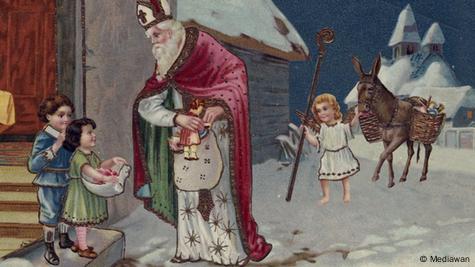
Image: Mediawan Santa Claus-Merry Christmas
St Nick Claus developed into an enormous, pudgy individual. Perhaps the earliest craftsman to characterize St Nick Claus' cutting edge picture was Thomas Nast, an American illustrator of the nineteenth century who deified St Nick Claus with a representation for the 3 January 1863 issue of Harper's Week by week in which Santa Clause was wearing an American banner, and had a manikin with the name "Jeff" composed on it, mirroring its Thoughtful Conflict setting. In this drawing, St Nick is likewise in a sled pulled by reindeers. consistently, on December 6, he strutted through the roads distributing treats and gifts to great kids. In the Netherlands, he was called Sinter Klaas. Dutch settlers ultimately carried him with them, to America. In the nineteenth hundred years, two writers and an illustrator in New Amsterdam (later known as New York City) made the cutting edge St Nick Claus.
It is believed that Nicholas was born sometime around A.D. 280 in Patara, near Myra in modern-day Turkey. Much admired for his piety and kindness, St. Nicholas became the subject of many legends. It is said that he gave away all of his inherited wealth and traveled the countryside helping the poor and sick.

If you were to request individuals where the legend from St Nick Claus started, they'd likely beginning by letting you know that the name "Santa Clause" is simply a moniker for Holy person Nicholas, a man who existed quite some time ago and was eminent for his liberality toward kids.
We catch wind of Holy person Scratch in songs like Rudolph the Red Nosed Reindeer, and stories like The Prior night Christmas, yet past that the man stays somewhat of a secret.
Apparently, his story starts in the fourth century Promotion in what is currently advanced Turkey. A man named Nicholas turned into the priest of a town called Myra. He was subsequently consecrated, and before long became perhaps of the most famous holy person in Christianity.

Santa Claus-Merry Christmas
That is pretty much all we know without a doubt yet a large part of the old stories encompassing Holy person Scratch discusses his benevolence and liberality toward youngsters, in our current reality where those mentalities weren't not difficult to track down.
Notwithstanding being the supporter holy person of numerous European nations including Russia, Austria, Belgium, France and Germany, it was in the Netherlands where we initially started to see some similarity to the St Nick Claus we knew all about today.
Every year, the much-cherished holy person was regarded during the Gala of Holy person Nicholas (or Sint-Nikolaas), where guardians would forget about gifts for their kids, who normally accepted Holy person Nicholas had visited them during the evening.
name "Santa Clause" is simply a moniker for Holy person Nicholas, a man who existed quite some time ago and was eminent for his liberality toward kids.

We catch wind of Holy person Scratch in songs like Rudolph the Red Nosed Reindeer, and stories like The Prior night Christmas, yet past that the man stays somewhat of a secret.
Apparently, his story starts in the fourth century Promotion in what is currently advanced Turkey. A man named Nicholas turned into the priest of a town called Myra. He was subsequently consecrated, and before long became perhaps of the most famous holy person in Christianity.
name "St Nick" is just a moniker for Heavenly individual Nicholas, a man who existed a long while prior and was prominent for his charity toward kids.
We find out about Blessed individual Scratch in tunes like Rudolph the Red Nosed Reindeer, and stories like The Earlier night Christmas, yet past that the man stays generally confidential

Santa Claus-Merry Christmas
Obviously, his story begins in the fourth century Advancement in what is at present high level Turkey. A man named Nicholas transformed into the cleric of a town called Myra. He was in this manner sanctified, and in a little while turned out to be maybe of the most renowned blessed individual in Christianity.
Obviously, his story begins in the fourth century Advancement in what is at present high level Turkey. A man named Nicholas transformed into the cleric of a town called Myra. He was in this manner sanctified, and in a little while turned out to be maybe of the most renowned blessed individual in Christianity.
St Nick's transition to America
Like most fantasies, the tale of Holy person Nicholas advanced and became adorned throughout the long term and - given their affection for him - it's not really unexpected to discover that in 1664, the legend of Holy person Nicholas ventured out across the Atlantic to Dutch settlement of New Amsterdam; or as it's known today, New York City.

Santa Claus-Merry Christma
In the 200 years that followed, and for the purpose of safeguarding their way of life and customs even with English settlement, a gathering of Dutch scholarly people assembled and considered themselves the "Knickerbockers."
A conspicuous individual from the gathering was an essayist named Washington Irving, who distributed a book called The Knickerbocker's Set of experiences of New York, containing humorous renditions of Dutch customs and stories.
All through the book there were a few dozen references to a "Sinter Klaas" - a variation of "Sint Nikolaas" - joined by subtleties of him flying across the sky in a cart and let presents fall down smokestacks for good young ladies and young men.
A conspicuous individual from the gathering was an essayist named Washington Irving, who distributed a book called The Knickerbocker's Set of experiences of New York, containing humorous renditions of Dutch customs and stories.
All through the book there were a few dozen references to a "Sinter Klaas" - a variation of "Sint Nikolaas" - joined by subtleties of him flying across the sky in a cart and let presents fall down smokestacks for good young ladies and young men.

Washington's wild, charming portrayal of the holy person immediately became known to New Yorkers. The English pilgrims energetically embraced the euphoric Dutch festivals of St. Nicholas' Day, and slowly started to consolidate them with their own customs of observing Christmas and the new year.
With regards to articulation, perceiving how "Sinter Klaas" could mean "St Nick Claus" when you apply the emphasize of an English-speaking New Yorker is simple.""
St Scratch's change to America
Like most dreams, the story of Sacred individual Nicholas progressed and became enhanced all through the long haul and - given their friendship for him - it's not exactly surprising to find that in 1664, the legend of Heavenly individual Nicholas branched out across the Atlantic to Dutch settlement of New Amsterdam; or as it's known today, New York City.
.jpeg)
In the 200 years that followed, and to defend their lifestyle and customs even with English settlement, a social occasion of Dutch insightful individuals gathered and viewed themselves as the "Knickerbockers."
An obvious person from the social occasion was a writer named Washington Irving, who circulated a book called The Knickerbocker's Arrangement of encounters of New York, containing entertaining interpretations of Dutch traditions and stories.
All through the book there were a couple dozen references to a "Sinter Klaas" - a variety of "Sint Nikolaas" - joined by nuances of him flying across the sky in a truck and let presents tumble down smokestacks for good young women and young fellows.
An obvious person from the social occasion was a writer named Washington Irving, who circulated a book called The Knickerbocker's Arrangement of encounters of New York, containing entertaining interpretations of Dutch traditions and stories.
All through the book there were a couple dozen references to a "Sinter Klaas" - a variety of "Sint Nikolaas" - joined by nuances of him flying across the sky in a truck and let presents tumble down smokestacks for good young women and young fellows.
.jpeg)
Washington's wild, beguiling depiction of the sacred individual promptly became known to New Yorkers. The English pioneers enthusiastically embraced the euphoric Dutch celebrations of St. Nicholas' Day, and gradually began to solidify them with their own traditions of noticing Christmas and the new year.
With respect to explanation, seeing how "Sinter Klaas" could imply "St Scratch Claus" when you apply the underscore of an English-speaking New Yorker is basic.""
During the 1800s, it was well known to draw St Nick Claus either in his priest's robes or as a man with a sharp cap, long coat, and straight facial hair. It was entirely expected to see St Nick drawn as very tall and thin.
This changed in 1863, when Harper's Week after week recruited a 21-year-old named Thomas Nast to draw an image of St Nick Claus carrying gifts to troops battling in the American Nationwide conflict.

Santa Claus-Merry Christmas
The St Nick that Thomas drew joined Lenient's portrayal of Holy person Nicholas from The Prior night Christmas with the intimately acquainted publicity picture of Uncle Sam.
Nast's St Nick was a sprightly, roly-poly elderly person who wore a star-radiant coat, striped pants, and a cap.
The drawing helped the spirits of fighters and regular citizens the same since it showed that the soul of Christmas had come to the Nationwide conflict," composed history specialist James I. Robertson.
It was well known to the point that consistently, for a considerable length of time, when the magazine requested that Nast draw Santas, he stayed with a similar idea - in spite of the fact that he did ultimately drop the stars and stripes for a plain fleece suit.

Santa Claus-Merry Christmas
Albeit this woolen suit was at some point green, Nast promoted Holy person Scratch's popular red garments, over forty years before The Coca-Cola Organization's portrayal of St Nick - in spite of the gossip that "Coca-Cola made Santa Clause red".
St Nick Claus Exists
So you don't have faith in St Nick Claus. It's reasonable. We end up during a time of unadulterated distrust. We question everything. Science has grabbed hold of our lives, giving responses to all inquiries and excusing whatever can't be made sense of as one or the other legend or fiction. So it's very justifiable why you don't accept, with no actual verification of his reality. It's to be sure reasonable to fail to focus on Father Christmas with the change of this occasion into one that, lately, is utilized economically as a rewarding bolster exclusively to create gain. It's reasonable to leave St Nick Claus subsequent to hearing innumerable individuals deny his exceptionally physical or even profound presence. All things considered, one tends to… show more happy…
With the wreaths and Yule logs that come norm with this occasion comes a minding from somewhere down in the hearts of individuals unbeknownst to them at some other season. At seeing the Christmas stylistic layout and the flares thundering at the hearth, a glow wraps the heart, one with which no fire, but hot, could contend. We find in our gift-wrap and our hello cards and our vacation stockings an altogether new persona possessing this world we live in, reprieving us from the everyday feelings of grief we as a whole know as recognizable.

St Nick Claus should exist. By what other method could you portray this adjustment of the manner in which people connect during these generally grim cold weather months? St Nick Claus is the impetus of human goodness, igniting inside us a certified consideration for our neighbor, uniting us for this great season. Consider a world without St Nick Claus!
Nowadays, St Nick Claus has advanced toward pretty much every edge of the world. Not as a marvel laborer or healer, but rather as a symbol of common, purchaser society. How might he all the while be a focal figure of a strict, Christian festival? Consistently, St Nick Claus has experienced harsh criticism. Take Dijon, France, where in 1951 a likeness of St Nick Claus was singed before a church. Furthermore, opposition is progressing, as we find in this film.

Santa Claus-Merry Christmas
Comments
Post a Comment